This Is Why Arequipa’s Architecture Steals Your Heart
You know that feeling when a city just gets you? Arequipa did exactly that—its whitewashed buildings glowing in the sun, nestled beneath a volcano, told stories without saying a word. I wandered for days, not ticking boxes, but truly seeing—the curves of colonial arches, the quiet courtyards, the fusion of Inca roots and Spanish dreams. This isn’t just travel; it’s connection. And it all starts with the stone. The way light dances across facades at dawn, the coolness under arcade walkways in midday heat, the deep shadows that pool in courtyards by dusk—each moment feels intentional, as if the city was built not just to be seen, but to be felt. Arequipa’s architecture is more than aesthetic; it’s a language of resilience, identity, and quiet beauty that speaks directly to the soul.
The Soul of Arequipa: A City Carved in Stone
Arequipa is often called “La Ciudad Blanca,” or The White City, a name earned not from paint, but from stone. The entire historic core is built from sillar, a porous white volcanic rock quarried from the slopes of the nearby Misti Volcano. This unique material gives the city its luminous quality, reflecting sunlight with a soft, almost ethereal glow. Unlike the gray or ochre tones common in other colonial cities, Arequipa radiates brightness, especially during the crisp Andean mornings when the air is clear and the sky stretches endlessly blue.
The widespread use of sillar wasn’t always the norm. Before the great earthquake of 1609, much of the city was constructed from adobe and wood, materials ill-suited to seismic activity. When the quake devastated the settlement, city planners made a decisive shift—rebuilding with sillar offered greater durability and fire resistance. This moment of destruction became a turning point, defining Arequipa’s architectural character for centuries to come. The stone, though soft enough to carve with precision, hardens over time, allowing for intricate details that have withstood both weather and time.
Walking through the city at different hours reveals how the architecture transforms with the light. At sunrise, the eastern facades catch the first golden rays, turning pale walls into warm canvases. By midday, the brightness intensifies, casting sharp contrasts between sunlit surfaces and deep shadows beneath arches and balconies. In the late afternoon, as the sun dips behind Misti, the western sides of buildings glow with a honeyed hue, while interiors of courtyards remain cool and dim, offering refuge from the heat. This dynamic interplay between light and stone creates a living cityscape, one that feels different with each passing hour, inviting visitors to return again and again to witness its subtle shifts.
Colonial Grandeur Meets Andean Resilience
The architecture of Arequipa is not simply a transplant of European design; it is a dialogue between two worlds. Spanish colonizers brought with them the formal symmetry, domed churches, and cloistered monasteries of Renaissance and Baroque traditions, but they built them using local materials and, crucially, local hands. Indigenous artisans, many trained in Inca stoneworking techniques, infused these colonial forms with their own sensibilities—resulting in a distinctive hybrid style known as Arequipeña Baroque. This fusion is evident in the delicate carvings above doorways, where European floral motifs intertwine with Andean symbols like the sun, the condor, and native plants.
One of the most striking examples of this synthesis is the Cathedral of Arequipa, which dominates the main plaza. Its twin bell towers rise in classical proportion, yet the stonework is distinctly Peruvian, with finely chiseled details that reflect both religious devotion and artistic mastery. The interior, though rebuilt after earthquake damage, maintains a sense of grandeur balanced with intimacy. Unlike the cavernous European cathedrals designed to inspire awe from a distance, Arequipa’s places of worship often feel more personal, their scale human and their ornamentation deeply rooted in local craftsmanship.
But the blending of cultures goes beyond aesthetics—it’s embedded in the very layout of buildings. Thick sillar walls serve a dual purpose: they provide insulation against the high-altitude temperature swings and offer structural stability in an earthquake-prone region. Yet these walls also reflect a cultural preference for inward-facing spaces. Many homes and religious complexes are designed with exterior facades that appear almost fortress-like, plain and unadorned, while their interiors open into lush courtyards filled with fountains, flowers, and shaded walkways. This architectural choice speaks to values of privacy, family, and community—spaces meant not for public display, but for quiet reflection and shared life.
Walking Slow Through Historic Center
The heart of Arequipa lies in its historic center, a UNESCO World Heritage site that unfolds like a carefully preserved manuscript. To walk here is to move through layers of time, where every street corner, plaza, and alleyway holds a quiet story. The Plaza de Armas, ringed by arcaded walkways, serves as the city’s living room—a place where locals gather in the morning for coffee, children play in the afternoon, and couples stroll as the sun sets. The rhythm is unhurried, inviting visitors to slow down and absorb the atmosphere rather than rush from landmark to landmark.
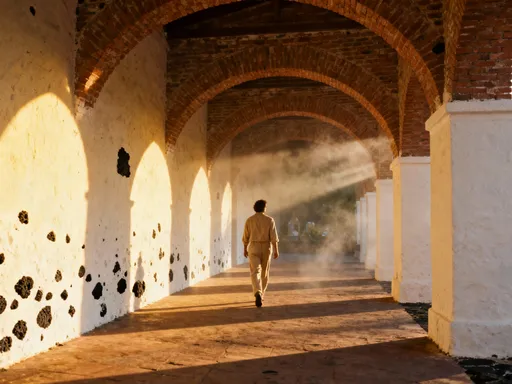
One of the joys of exploring this district is the sensory richness of the experience. The cobblestone streets, worn smooth by centuries of footsteps, echo softly with each step. The arcades provide shelter from both sun and rain, their shaded corridors offering a cool respite where light filters in at oblique angles, illuminating dust motes and carved stonework alike. Beneath wooden balconies—many painted in deep reds or greens—clusters of potted plants spill over, adding splashes of color and the occasional scent of jasmine or eucalyptus drifting from inner courtyards.
Attention to detail is everywhere. Doorways are often framed with intricate stonework, some bearing family crests or religious inscriptions. Look up, and you might spot a hidden fresco beneath a balcony roof or a carved angel peering down from a cornice. These small discoveries make the experience deeply personal, as if the city is revealing its secrets only to those who take the time to look. There is no need to rush; the beauty here is not in grand monuments alone, but in the quiet accumulation of moments—the way light falls across a courtyard fountain, the sound of a door creaking open, the glimpse of a gardener tending roses behind a wrought-iron gate.
Santa Catalina Monastery: A City Within a City
No visit to Arequipa is complete without stepping into the world of Santa Catalina Monastery, a 20-acre complex that feels less like a single building and more like a miniature city enclosed within thick stone walls. Founded in 1579, it was home to a community of cloistered nuns for over 400 years, many from wealthy families who brought their servants and lived in relative luxury within its maze-like corridors. Today, it stands as one of Peru’s most remarkable architectural treasures, offering a rare glimpse into a secluded way of life.
The monastery’s layout is both orderly and labyrinthine. Wide streets divide color-coded zones—blue for contemplation, orange for service, white for community—guiding residents through a structured daily rhythm. As visitors wander the narrow alleys, they encounter sudden openings into sunlit patios, small chapels, and kitchens with original clay ovens. The contrast between the austere outer walls and the vibrant interiors is striking: cobalt-blue doors, terracotta-red walls, and wooden balconies overflowing with flowers create a sense of warmth and intimacy, even in spaces designed for solitude.
What makes Santa Catalina so powerful is the way it invites slowness. To truly appreciate it, one must pause often—listening to the wind through the bell tower, reading the plaques that tell stories of nuns who lived and died within these walls, or simply sitting on a bench and watching light shift across a courtyard. The architecture here is not just functional; it is spiritual. The thick walls muffle outside noise, creating a sanctuary where silence becomes its own form of communication. Every arch, every doorway, every hidden garden seems to whisper of devotion, discipline, and the quiet dignity of a life lived in service and prayer.
Living Architecture: Homes and Hidden Courtyards
Beyond the major landmarks, Arequipa’s residential neighborhoods preserve another layer of its architectural heritage. Scattered throughout the city are hundreds of casonas—colonial-era mansions built by aristocratic families, merchants, and landowners. These homes, often hidden behind unassuming facades, open into spacious courtyards surrounded by arched walkways, fountains, and lush greenery. Though many have been subdivided or repurposed over time, a growing number are being restored with care, blending historical integrity with modern comfort.
Some of these casonas have been transformed into boutique hotels, restaurants, or cultural centers, allowing visitors to experience colonial living firsthand. Staying in one offers a rare privilege: falling asleep to the sound of water trickling in a courtyard fountain, waking to sunlight filtering through wooden lattices, and sipping morning tea beneath a covered gallery where generations once gathered. These spaces are not museum pieces; they are lived-in, loved, and adapted to contemporary life without losing their essence.
More intimate still are the private homes that remain in family hands. In some cases, descendants of the original owners still live in these houses, preserving traditions and stories passed down through generations. With permission, visitors can sometimes tour these spaces, guided by caretakers who speak with pride about the history embedded in the walls. One elderly woman, whose family has lived in the same casona since the 1800s, described how her grandmother would gather the children in the courtyard each evening to tell stories under the stars. “The house remembers,” she said, “even when people forget.” This sense of continuity—of architecture as a vessel for memory—is one of Arequipa’s quietest, yet most profound gifts.
Beyond the Center: Neighborhoods with Character
While the historic center draws most visitors, Arequipa’s charm extends well beyond its UNESCO core. Neighborhoods like Yanahuara and Cayma offer a more local perspective, where daily life unfolds at a gentler pace and architecture remains deeply rooted in tradition. Yanahuara, perched on a hillside south of the city, is known for its elegant plaza built entirely of sillar, framed by arched colonnades and crowned with a small church. From this vantage point, the view of Misti Volcano is breathtaking, especially at sunset when the snow-capped peak glows pink against the evening sky.
The houses in Yanahuara reflect a blend of colonial and republican styles, with ornate wooden balconies and iron grilles that hint at the prosperity of 19th-century families. Unlike the more commercialized center, this district retains a strong sense of community. Neighbors greet each other by name, children play in the plaza, and small family-run bakeries sell fresh picarones and queso helado. There is a pride in preservation here—many homes have been maintained for over a century, with repairs done using traditional methods and materials.
Cayma, one of Arequipa’s oldest neighborhoods, offers a similar sense of continuity. Its narrow streets wind past houses with thick stone walls and tiled roofs, many centered around private patios that remain invisible from the street. The Church of Cayma, dating back to the 17th century, stands as a testament to enduring faith and craftsmanship, its façade adorned with intricate carvings and its interior housing centuries-old religious art. Walking through Cayma feels like stepping into a quieter version of the city—one where time moves differently, and the past is not something to be curated, but lived.
Why Slow Travel Fits Arequipa Perfectly
Arequipa is not a city that reveals itself in a single day. Its architecture, so rich in detail and meaning, demands time and attention. Rushing through its plazas and monuments means missing the subtle language of its stones—the way a shadow falls across a carving, the sound of wind through a cloister, the quiet dignity of a courtyard untouched by crowds. This is a place where slow travel is not just recommended; it is essential.
One of the most rewarding ways to experience the city is by staying in a restored casona. These accommodations offer more than comfort; they provide immersion. Waking up in a room with 12-foot ceilings, walking through a garden where bougainvillea climbs ancient walls, and sharing breakfast with a host who knows the neighborhood’s history—these moments create a deeper connection than any guided tour can offer. Equally valuable is hiring a local guide, particularly one with roots in the city. Their stories—about families who built certain homes, the meaning behind architectural details, or how festivals were celebrated in courtyards a century ago—add layers of understanding that transform sightseeing into storytelling.
Timing matters, too. Visiting the main plaza early in the morning, before the tour groups arrive, allows for a different kind of encounter—one filled with the quiet hum of daily life rather than the buzz of cameras and loud voices. Similarly, returning to the same courtyard or alley at dusk offers a completely new perspective, as shadows lengthen and the city takes on a more introspective mood. And because Arequipa’s architecture is so responsive to light, photographing the same building at different times can yield dramatically different results, each revealing a new facet of its character.
Perhaps most importantly, slow travel in Arequipa fosters a sense of presence. It encourages visitors to put down their phones, step out of the mindset of checking off destinations, and simply be. To sit on a bench and watch sunlight move across a wall. To listen to the distant chime of church bells. To notice the way a single rose blooms in a stone planter. These are not grand events, but they are the moments that linger—small, quiet, and deeply human.
Arequipa doesn’t shout—it murmurs, through archways and quiet patios, inviting you to listen. Its architecture isn’t just beautiful; it’s alive with memory and meaning. When you move slowly, the city reveals itself, not as a checklist, but as a conversation across centuries. In a world that races, that’s a rare gift.